

At 6 AM, a single employee unlocks the doors to a convenience store, begins the opening routine, and for the next two hours becomes one of thousands of retail workers operating alone across Canada – often without anyone recognizing the complex safety implications this creates.
Later that evening, after the last customer leaves a boutique, another employee counts the register, locks the safe, and walks alone to their car, completing another high-risk transition that most retailers haven’t systematically addressed.
At ProTELEC, we’ve worked with hundreds of retail businesses to understand and address these overlooked vulnerabilities. Lean staffing, extended hours, and cost pressures have created situations where employees routinely work without immediate backup, but most retailers lack the expertise to properly assess risks, understand regulatory requirements, and implement effective solutions.
Understanding workplace hazards and implementing work alone monitoring requires both industry-specific knowledge and technical expertise. That’s why we guide retail clients through every aspect of lone worker safety – from initial risk assessment through full implementation and ongoing compliance management.
The Complex Reality of Retail Lone Worker Situations
When we begin working with a new retail client, one of our first steps is helping them understand the full scope of their lone worker exposure. Recent comprehensive surveys reveal statistics that concern every business owner we work with:
- 27% of retail employees report feeling unsafe at work
- 53% have witnessed customer aggression or harassment
- 1 in 10 experienced physical assault in the past year
- 74% report sometimes feeling unsafe during shifts
But these statistics only tell part of the story. In Canada, the Retail Council reports that violent incidents, including aggressive shoplifting and assault, have become daily concerns since the pandemic. The problem extends beyond high-crime areas – even suburban shopping centers report increased incidents of customer aggression, theft, and harassment.
Our risk assessments consistently reveal industry-specific vulnerabilities that require specialized approaches:
Convenience Stores face disproportionately high crime risks, with these businesses accounting for 10% of all robberies despite representing a much smaller fraction of retail establishments. Recent FBI data shows that convenience stores and gas stations combined were the sites of 13.8% of all robberies, making convenience stores the 4th most common location for violent crime overall. We work with convenience store clients to develop comprehensive monitoring systems that account for cash handling procedures, overnight operations, and the unique challenges of locations that never close.
Pharmacies dealing with controlled substances report increased theft attempts and customer aggression, often targeting lone staff members during slower periods. Our pharmaceutical retail solutions address the specific regulatory requirements and security challenges these businesses face.
Cannabis Retailers operate under unique constraints including cash-only operations and strict regulatory oversight, creating complex lone worker scenarios. We specialize in developing compliant safety solutions that work within the regulatory framework while providing comprehensive staff protection.
Jewelry and Electronics Stores remain prime targets for organized theft, with criminals often studying staff patterns and timing their attempts for moments when employees are isolated. Our solutions for high-value retailers include sophisticated detection and response capabilities tailored to these elevated threat levels.
Gas Stations and Automotive Service locations experience elevated risks during overnight hours, early morning, and late evening operations when staff are most vulnerable. We develop monitoring solutions that account for both indoor and outdoor work areas, multiple service bays, and the unique challenges of petroleum retail environments.
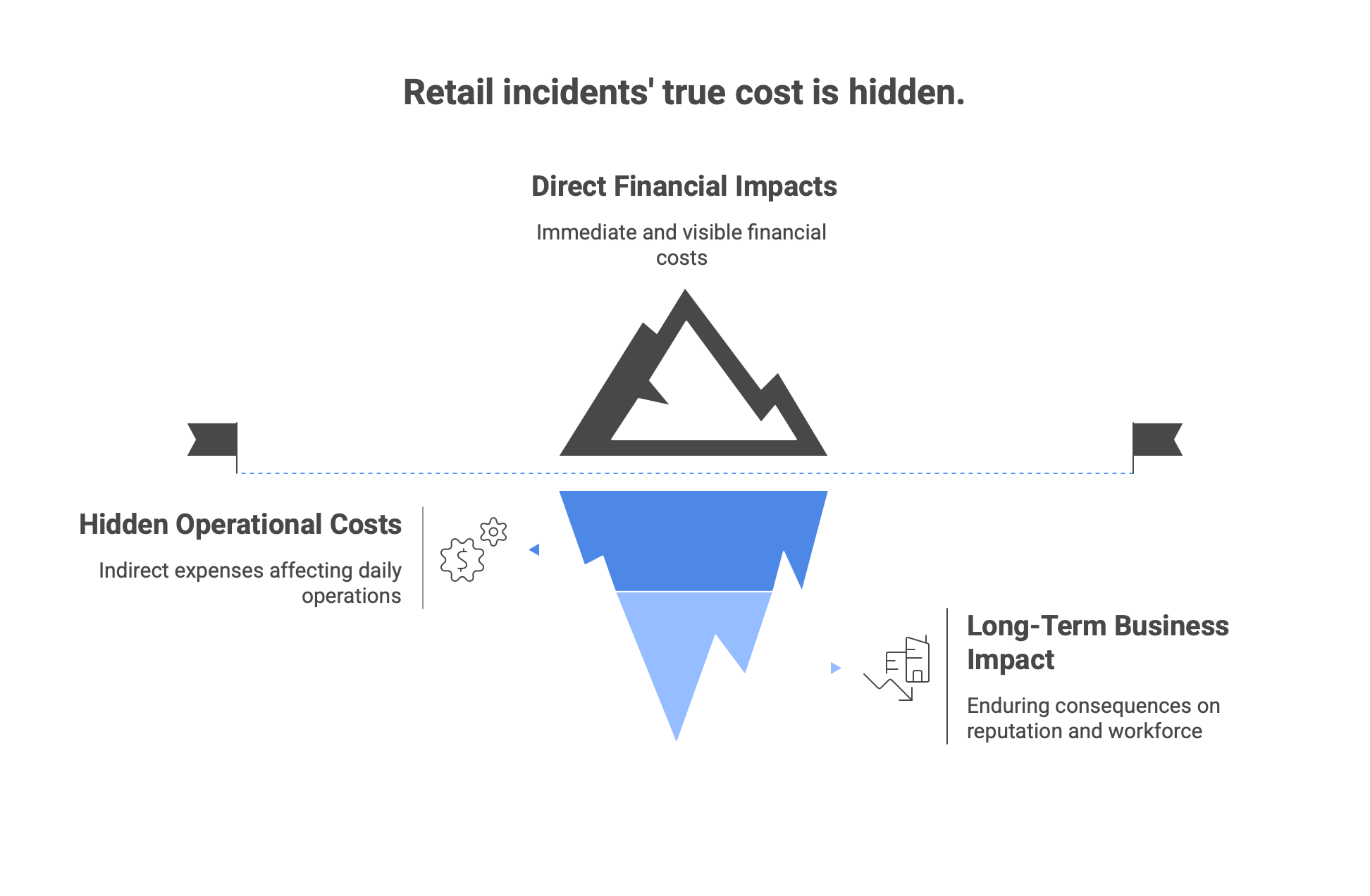
Direct Financial Impacts:
- Workers’ compensation claims averaging $44,179 per incident (NCCI data)
- Medical expenses including emergency care, ongoing treatment, and rehabilitation
- Lost productivity during employee recovery and replacement training
- Legal costs for incident investigation and potential litigation
Hidden Operational Costs:
- Store closure during incident response and investigation
- Increased insurance premiums that can persist for years after claims
- Recruitment and training costs for replacement employees
- Overtime expenses covering shifts for injured workers
Long-Term Business Impact:
- Reputation damage from publicized incidents affecting customer confidence
- Staff turnover as employees seek “safer” employment options
- Reduced productivity from heightened security concerns affecting customer service
- Regulatory scrutiny potentially leading to increased compliance costs
For many retailers, a single serious incident can cost more than several years of prevention investments – making proactive safety measures a sound business decision independent of regulatory requirements.
Navigating Retail-Specific Regulatory Requirements
One of the most challenging aspects of retail lone worker safety is understanding and complying with the complex web of provincial regulations, many of which include industry-specific requirements that generic safety providers don’t understand.
Our experience working with retail businesses across Canada has given us deep expertise in how different provinces regulate lone worker safety in retail environments, including special requirements that apply specifically to retail operations.
Federal Baseline Requirements under Canada Labour Code Part II require employers to “take every reasonable precaution” to protect worker health and safety, including employees working alone. However, provincial implementation creates significant variations that retail businesses must navigate carefully.
Ontario’s Requirements for retail businesses include specific provisions for adequate supervision and communication during isolated work, with particular attention to late-night operations. We help Ontario retailers understand not just the basic requirements, but how recent enforcement actions have clarified what “adequate” actually means in practice.
Alberta’s Occupational Health and Safety Code mandates written procedures and regular contact systems, with specific documentation requirements that many retailers find overwhelming. We guide Alberta retail clients through developing the detailed procedures required while keeping them practical for daily operations.
British Columbia’s Detailed Regulations include specific provisions for retail operations, particularly late-night businesses. These requirements cover everything from panic alarm systems to physical barriers and cash handling limits. We help BC retailers implement compliant solutions that enhance security without disrupting customer experience.
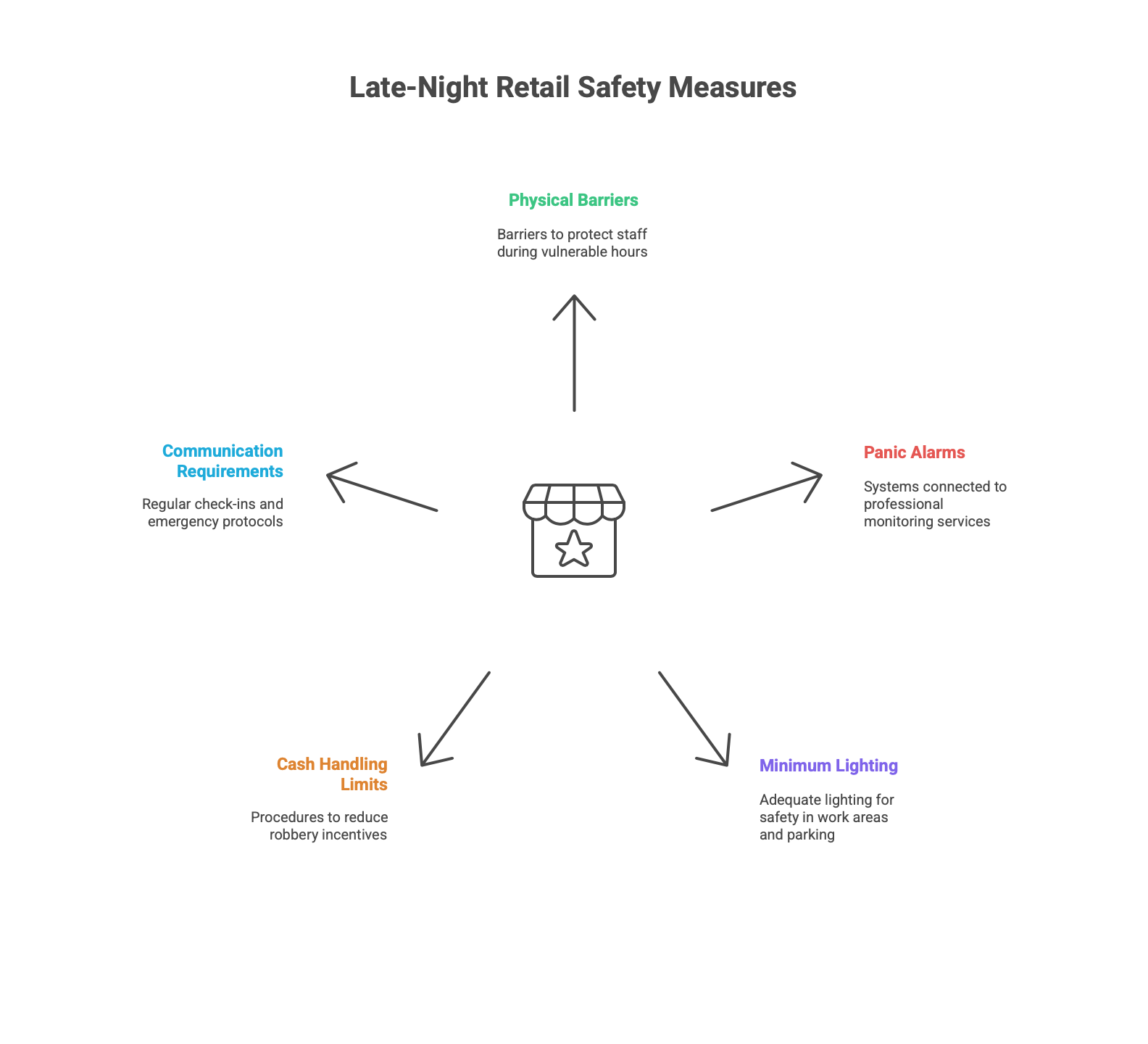
Late-Night Retail Specific Rules exist in several provinces and include requirements that generic safety providers often miss:
- Physical barriers separating staff from customers during vulnerable hours
- Panic alarm systems with direct connection to professional monitoring services
- Minimum lighting requirements for employee work areas and parking
- Cash handling limits and procedures designed to reduce robbery incentives
- Communication requirements including regular check-ins and emergency protocols
Documentation and Compliance Monitoring requirements vary significantly between provinces, but all require systematic record-keeping that demonstrates ongoing compliance. We help retail clients establish and maintain documentation systems that satisfy regulatory requirements while providing valuable operational insights.
Our Comprehensive Retail Risk Assessment Process
When we begin working with a new retail client, our first step is always a thorough risk assessment that goes far beyond generic safety checklists. We analyze your specific retail environment, operations, and challenges to develop solutions that work in the real world.
Operational Analysis We observe your business during different times, seasons, and situations to understand when and where staff work alone. This includes busy periods where staff might be functionally isolated, slow periods with minimal coverage, and transition times like opening and closing when vulnerabilities peak.
Location-Specific Risk Evaluation Every retail location has unique characteristics that affect lone worker safety. We evaluate everything from parking lot lighting and sight lines to stockroom layout and communication dead zones. Our assessment identifies specific vulnerabilities that generic solutions miss.
Regulatory Compliance Review Based on your location, business type, and operations, we analyze exactly what provincial and local requirements apply to your situation. This includes current regulations, upcoming changes, and enforcement patterns that could affect your compliance status.
Staff Workflow Documentation We study how your staff actually work – not how procedures say they should work. This real-world understanding is crucial for developing solutions that people will use consistently rather than work around or ignore.
Technology Infrastructure Assessment We evaluate your existing security systems, point-of-sale technology, and communication capabilities to understand what can be leveraged and what needs enhancement. This includes testing coverage in problem areas and assessing integration possibilities.
Threat Assessment We analyze crime patterns in your area, review incident histories, and evaluate specific threats your business type faces. This helps us design monitoring systems that address your actual risks rather than theoretical concerns.
Our Solution Architecture: Tailored to Retail Realities
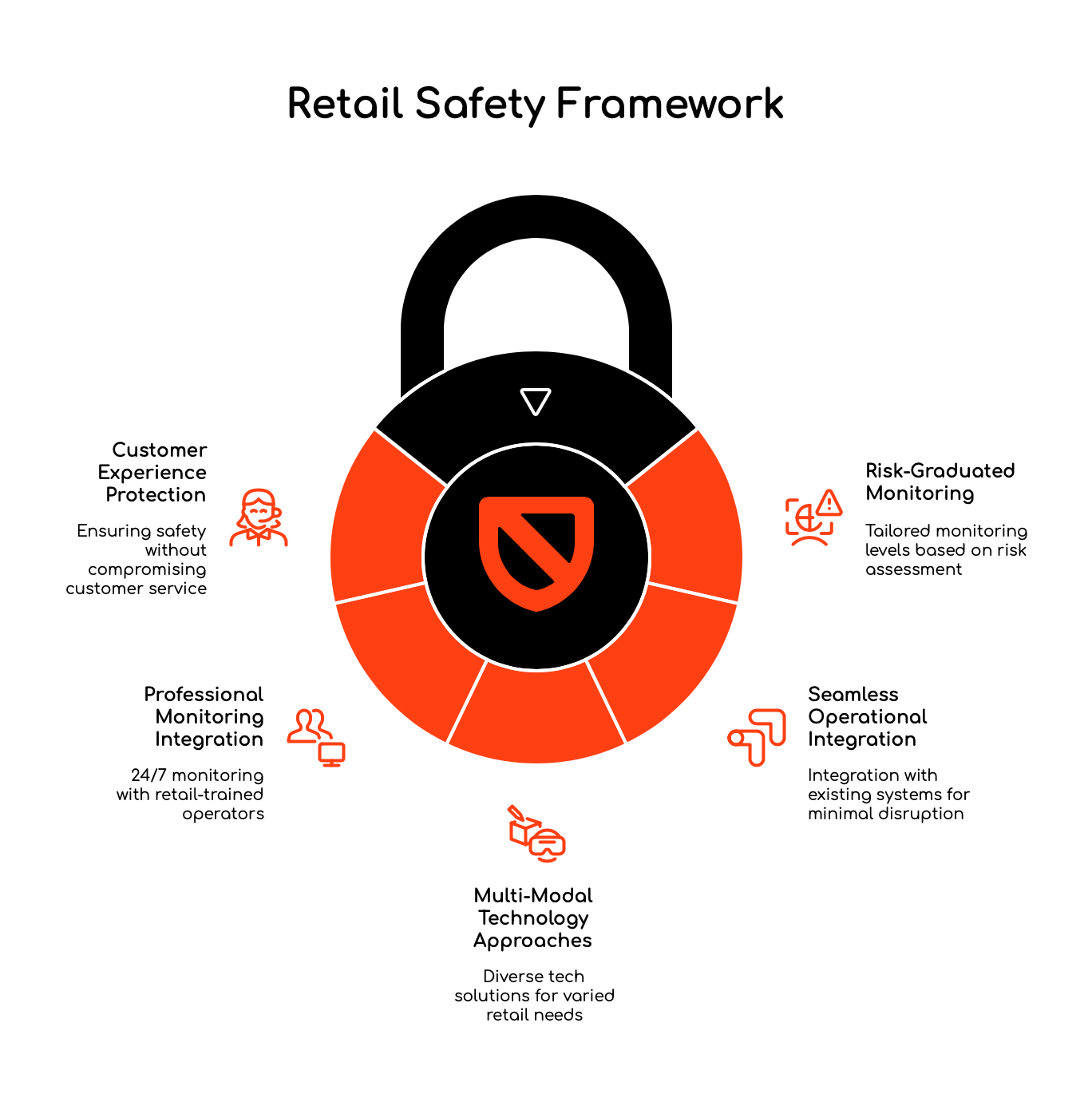
Based on our comprehensive assessment, we design integrated lone worker safety solutions that address your specific challenges while meeting all regulatory requirements. This isn’t about implementing generic monitoring – it’s about creating systems that enhance both safety and operations.
Risk-Graduated Monitoring Systems Different retail situations require different levels of monitoring. High-risk activities like cash handling and closing procedures get intensive monitoring, while lower-risk situations get appropriate but less intrusive protection. We design systems that match protection to actual risk levels.
Seamless Operational Integration Our retail solutions work with your existing workflows, not against them. We integrate lone worker protection with your current security systems, point-of-sale processes, and staff routines. The goal is protection that enhances rather than disrupts customer service.
Multi-Modal Technology Approaches Retail environments require diverse technological solutions. We might combine automated check-in systems for opening/closing routines, discrete panic buttons for customer-facing staff, GPS tracking for employees making deposits, and 24/7 professional monitoring backup for all situations. Each solution is matched to specific needs and risk levels.
Professional Monitoring Integration All our retail solutions include access to our ULC-certified monitoring center, staffed 24/7 by operators trained specifically in retail emergency protocols. When an alert is triggered, our operators understand retail environments, can assess customer vs. security situations, and coordinate with law enforcement using business-specific procedures.
Customer Experience Protection Our retail solutions are designed to protect staff without negatively impacting customer experience. Discrete monitoring capabilities, customer-friendly emergency procedures, and systems that work invisibly during normal operations ensure safety enhancement doesn’t compromise sales.
Implementation Process: Minimizing Disruption While Maximizing Protection
Our retail implementation process is designed around the reality that retail businesses can’t shut down for safety installations. We’ve developed systematic approaches that ensure comprehensive protection while maintaining normal operations.
Phase 1: Critical Risk Coverage We start by implementing monitoring for the highest-risk situations – typically opening/closing procedures, cash handling, and overnight operations. This provides immediate protection for the most vulnerable situations while allowing us to refine procedures before broader implementation.
Phase 2: Operational Integration Once foundation systems are working smoothly, we expand coverage to include staff working in stockrooms, employees handling deposits, and other moderate-risk situations. This phase focuses on seamless integration with daily operations and staff training for consistent adoption.
Phase 3: Comprehensive Coverage The final phase extends protection to all lone worker situations and integrates monitoring with your broader security infrastructure. This creates a comprehensive safety framework where lone worker protection works seamlessly with other security measures.
Staff Training and Change Management Retail staff have demanding jobs with high customer interaction requirements. Our training programs help staff understand how to use safety systems efficiently without impacting customer service. We focus on making safety procedures feel natural rather than burdensome.
Ongoing Optimization and Support We don’t disappear after installation. Our team provides ongoing monitoring of system effectiveness, regular compliance reviews, and continuous optimization based on changing needs and evolving threats. This includes quarterly system testing, annual risk reassessments, and immediate support for emerging challenges.
Why Retailers Choose CheckMate: Expertise That Makes the Difference
Retailers who work with us consistently tell us that what sets CheckMate apart is our deep understanding of retail operations and our comprehensive approach to guiding them through every aspect of lone worker safety.
Retail Industry Specialization We understand retail. Our team has worked with hundreds of retail businesses, from single-location shops to national chains. We understand the unique pressures retailers face – tight margins, customer service requirements, regulatory complexity, and the need for solutions that enhance rather than complicate operations.
Complete Solution Development We don’t just sell monitoring technology – we architect complete safety solutions tailored to each retailer’s specific needs. This includes risk assessment, regulatory compliance analysis, technology selection and integration, staff training, and ongoing optimization.
Professional Monitoring Excellence Our ULC-certified monitoring center operates 24/7 with operators specifically trained in retail emergency protocols. When an alert comes from one of our retail clients, our operators understand the difference between customer service situations and genuine emergencies, know the right questions to ask, and can coordinate appropriate responses.
Proven Implementation Methodology Our systematic implementation approach minimizes disruption while ensuring comprehensive coverage. We’ve refined this process through hundreds of retail installations, eliminating the trial-and-error phase that retailers would face trying to develop solutions independently.
Long-Term Partnership Approach We view our relationships with retailers as ongoing partnerships, not one-time sales. Our team provides continuous support, regular system optimization, compliance monitoring, and immediate assistance with any emerging challenges or changing requirements.
ROI That Goes Beyond Incident Prevention

Our retail clients consistently see returns on their lone worker safety investments through multiple channels that extend beyond prevented incidents.
Insurance Premium Reductions Many commercial insurance providers offer significant discounts for retailers with documented, professionally-implemented safety programs. We help clients document their programs to maximize these discounts, often reducing workers’ compensation and liability premiums by 15-25%.
Reduced Turnover Costs Retail already faces high turnover rates, but employees who feel genuinely protected stay longer. Reducing turnover – which can cost $3,000-$5,000 per replacement in retail – often justifies safety investments independently of incident prevention.
Enhanced Customer Confidence Customers notice stores where staff appear confident and secure. Professional safety measures signal that you care about your employees and take security seriously, which builds customer trust and loyalty.
Operational Continuity Protection Preventing incidents means avoiding store closures, maintaining consistent staffing, and protecting revenue streams. Even minor incidents can disrupt operations and create costly complications that effective monitoring helps avoid.
Legal Protection and Compliance Assurance Our documented procedures and professional monitoring provide strong legal protection should incidents occur. Courts expect employers to demonstrate systematic approaches to worker protection, particularly for known risks like lone worker situations.
Starting Your Lone Worker Safety Journey
Every retailer’s lone worker safety needs are unique, which is why our process always begins with understanding your specific situation, challenges, and operational requirements.
Initial Consultation We start with a comprehensive discussion of your current situation, including business type, locations, staffing patterns, existing security measures, and budget considerations. This consultation helps us understand not just what you need, but how to implement solutions that work within your retail environment.
Comprehensive Assessment Based on our initial consultation, we conduct a thorough assessment of your facilities, operations, and current safety infrastructure. This assessment identifies specific vulnerabilities, evaluates existing resources, and documents regulatory compliance requirements for your jurisdiction and business type.
Tailored Solution Design We develop a comprehensive lone worker safety solution designed specifically for your retail operation and present it with clear implementation timelines, cost projections, and expected outcomes. This isn’t a generic proposal – it’s a detailed roadmap for achieving comprehensive protection that enhances your operations.
Implementation Planning Once you decide to move forward, we develop a detailed implementation plan that ensures systematic deployment of safety protections while maintaining normal business operations. This includes staff training schedules, technology installation timelines, and integration with existing systems.
Ongoing Partnership Our relationship continues long after initial implementation. We provide regular system monitoring, compliance reviews, optimization recommendations, and immediate support for any challenges that emerge. You’re not just buying technology – you’re gaining a long-term safety partner who understands retail.
The Time for Professional Guidance is Now
Lone worker safety in retail isn’t just about regulatory compliance – it’s about protecting your team while maintaining the customer service and operational efficiency that drive your business success. The challenges are complex, the regulations are evolving, and the stakes are too high for generic solutions or DIY approaches.
At ProTELEC, we’ve spent years developing the retail-specific expertise, systems, and processes needed to protect retail staff comprehensively while enhancing rather than complicating business operations. We understand the unique challenges retailers face, the regulatory requirements they must meet, and the operational constraints they operate under.
Your employees face real risks when working alone – risks that multiply in retail environments with customer interaction, cash handling, and irregular schedules. They deserve systematic protection that gives them confidence and peace of mind while meeting all your legal obligations and operational needs.
The question isn’t whether your retail business needs comprehensive lone worker protection – it’s whether you’ll work with experts who understand retail and can guide you through every aspect of implementation.
Ready to discover how much your business could be saving with CheckMate? Try our free ROI calculator below.